Copilot may know that your seller emailed a customer yesterday, that a contract draft sits in SharePoint, and that a follow-up meeting is scheduled for Friday. But can it explain why the deal is stalled, which approval is holding it up, and what your team should do next?
That is where workplace context meets business context—and where enterprise AI has often struggled.
Email, meetings, and documents tell part of the story. The rest lives in customer records, opportunity stages, case histories, custom applications, and the rules your organization uses to make decisions. Connecting those sources is important. Understanding how they fit together is what makes the answer useful.
Microsoft's Business Applications in Work IQ preview addresses that gap. It extends Work IQ's workplace intelligence into business application data and processes, starting with documented support for Dynamics 365 Sales, Dynamics 365 Customer Service, and Power Apps model-driven apps.
For organizations invested in Dynamics 365, Dataverse, and Power Platform, the opportunity is significant: more useful Copilot experiences built on a shared understanding of the business, rather than another collection of disconnected agents.
But the value will depend as much on the foundations underneath the technology as on the technology itself.
Part 1From work context to business context
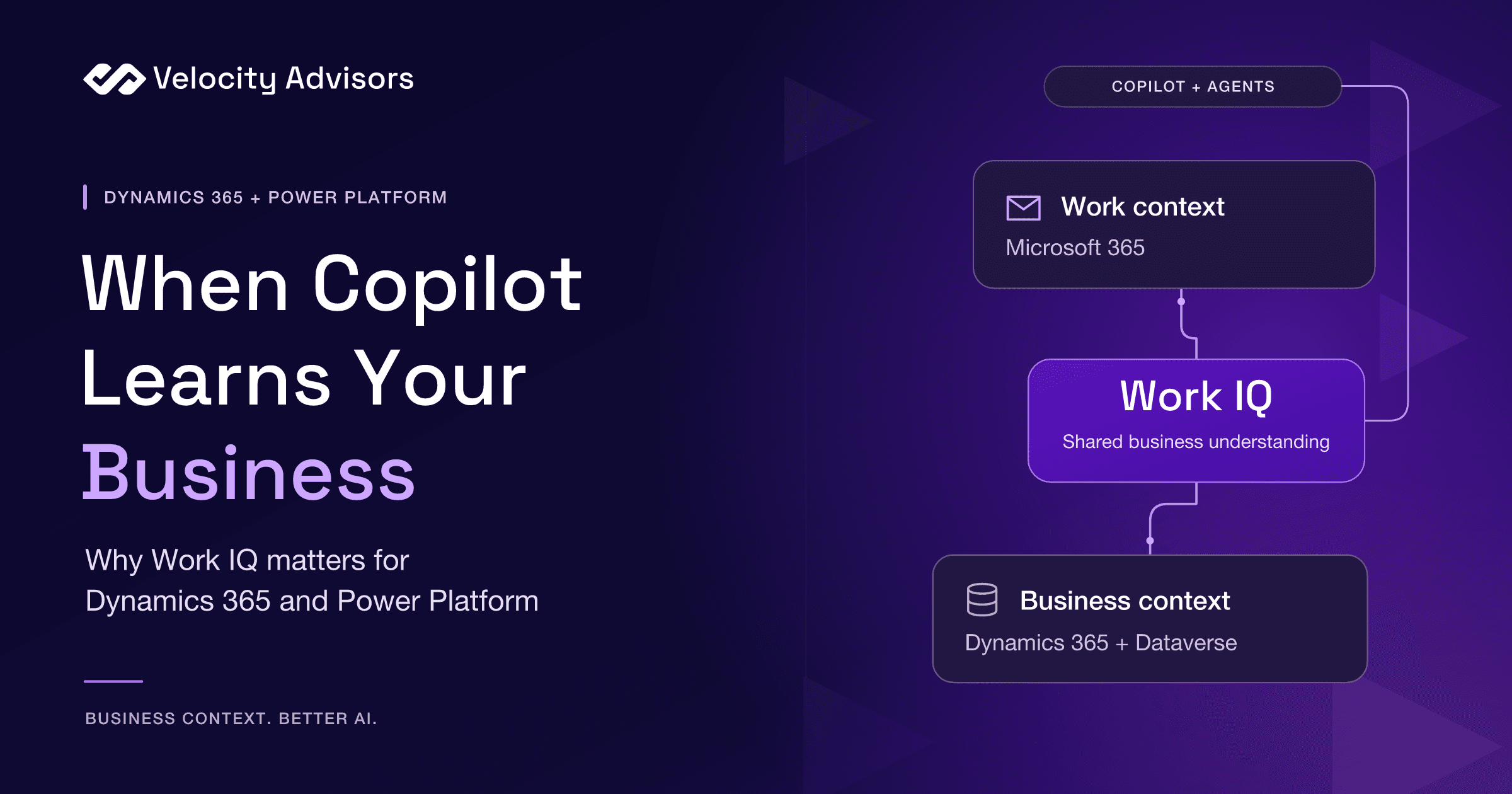
Work IQ brings together context about how people work: their relationships, communications, and relevant content across Microsoft 365. Business Applications in Work IQ adds context about how the organization operates.
Microsoft's announcement describes a public preview beginning September 30, 2026, with rollout continuing through October.
The shift is more than another connection to business data. Work IQ provides a common way for supported Copilot and agent experiences to discover, read, and act on application data while retaining each application's data model, permissions, and governance.
Consider a sales manager preparing for a forecast call. Finding the latest customer email is helpful. Answering a question such as, "Which contracts are awaiting approval, and which opportunities could those delays affect?" requires something more.
If contract approvals are managed in the organization's Dataverse applications, a useful answer depends on understanding how contracts relate to opportunities, what approval statuses mean, and which dependencies matter to the forecast.
The goal is to connect what people are doing with what the business needs to accomplish.
Part 2The real unlock: shared business understanding
Two capabilities are central to that approach: business skills and the Dataverse semantic model.
They address different sides of the same problem. An AI system needs to understand both what the data means and how the organization expects work to be done.
| Capability | What it supplies |
|---|---|
| Business skills | How the organization expects work to be done: process guidance, business rules, and supporting resources. |
| Semantic model | What the data means: relationships, views, descriptions, and the glossary terms a schema cannot infer. |
Business skills capture the playbook
Every organization has operating knowledge that is difficult to find in a table or field.
What qualifies an opportunity? When should a case be escalated? Which evidence must be reviewed before recommending a discount? Who needs to approve the next step?
Too often, that knowledge lives in experienced employees' heads, scattered documents, or instructions copied into individual agents.
Business skills provide a way to capture reusable process guidance, business rules, and supporting resources. Teams can define a process once and make it available to agents that have access to it, rather than rebuilding the same instructions for every experience.
A renewal-readiness skill, for example, could guide an agent to review unresolved service issues, identify the responsible owner, confirm customer commitments, and seek approval before proposing a concession.
There is an important distinction: business skills are natural-language guidance, not executable code. They help agents follow the organization's playbook; they do not replace security controls, approval workflows, or application-enforced rules.
The semantic model explains the data
The Dataverse semantic model gives supported agents and Copilot experiences a shared, business-aware interpretation of Dataverse data.
Instead of relying only on table and column names, it draws on existing application configuration, including relationships, views, form names, and table and column descriptions. Makers and administrators can refine those signals and add glossary terms for language the system cannot infer.
That last point matters. Automatic generation reduces setup effort, but it does not eliminate the need for business input.
If "strategic account" or "at risk" has a specific meaning in your organization, that meaning needs to be represented clearly. The semantic model provides a foundation—not a substitute for agreement about how the business works.
Together, skills and semantics move the experience beyond retrieving records toward interpreting them in context.
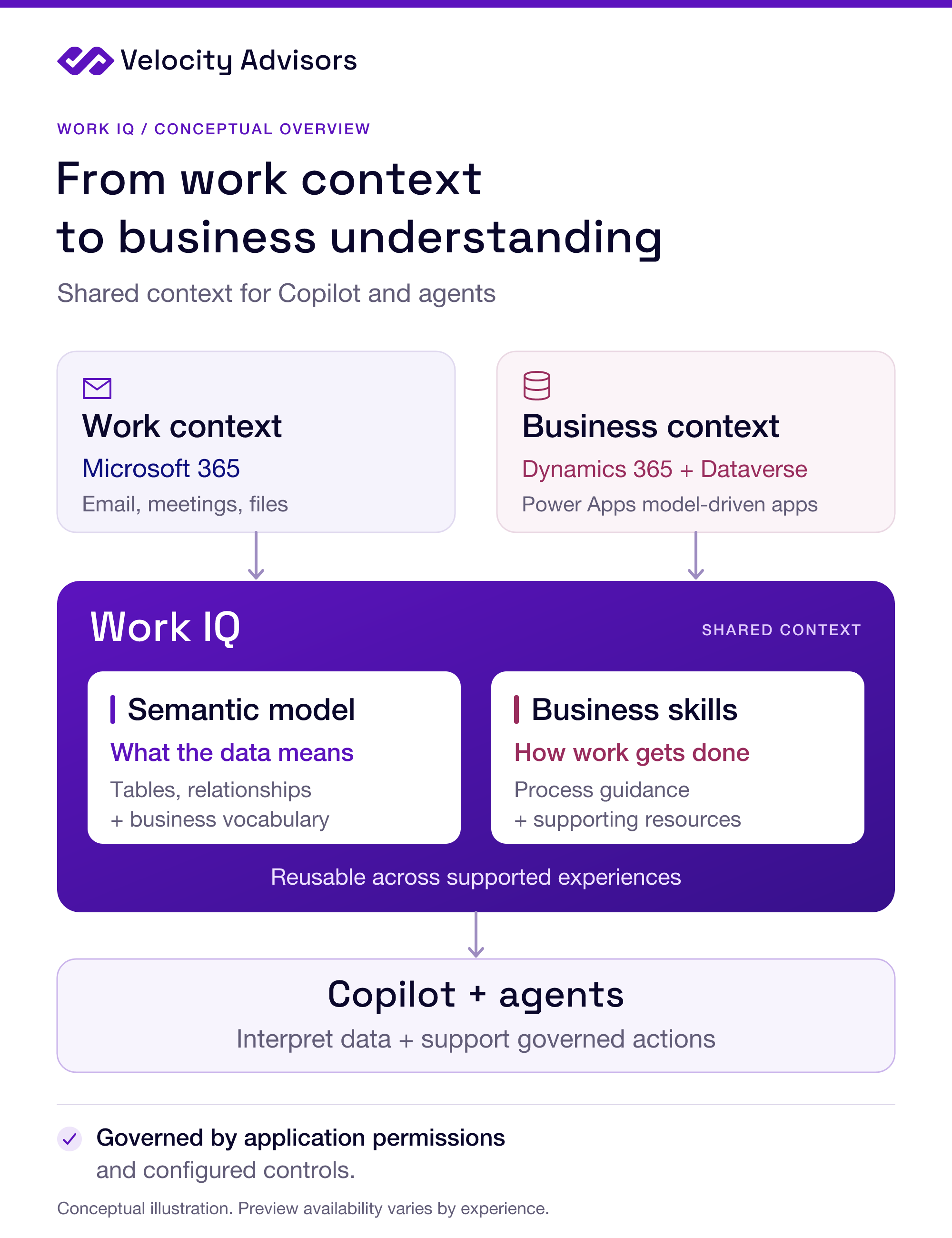 View the diagram at full size.
Part 3What this means for Dynamics 365 and Power Platform
For Dynamics 365 Sales and Customer Service teams, the immediate opportunity is less time piecing together information across applications and more time acting on it.
A seller could investigate an opportunity alongside related customer communications. A service manager could explore case information using the organization's terminology and escalation guidance. A custom model-driven application could contribute business context without requiring an entirely separate AI knowledge layer.
Where supported and appropriately configured, that context can also support actions in the source applications—not just answers.
For makers and developers, the broader benefit is reuse. Business understanding can become a shared foundation across supported Copilot, agent-building, and coding experiences, rather than a separate interpretation maintained inside each agent.
That is the strategic significance of Work IQ. Dynamics 365 and Power Apps are not simply additional data sources. Their existing configuration and processes can help shape how AI interprets the business.
Microsoft is also extending this pattern toward additional applications and integrations, including through Model Context Protocol, or MCP. Organizations should distinguish that direction from what is supported and available in their environments today.
Part 4What to understand before adopting it
The opportunity is real, but so are the implementation considerations.
Preview is not production readiness. Microsoft identifies Business Applications in Work IQ as a preview capability, subject to change and supplemental terms, and not intended for production use. Treat it as an opportunity for controlled evaluation—not a dependency for a committed production rollout.
Review the defaults, not just the setup steps. Microsoft's current rollout guidance enables the capabilities by default for eligible new production environments starting September 30, 2026, with eligible existing environments scheduled to follow starting in November. Regional, environment-type, and cloud exceptions apply. Administrators should review tenant, environment, and application settings rather than assume adoption always begins with a deliberate opt-in.
Existing permissions still need scrutiny. Work IQ uses underlying application permissions to determine what users, agents, and applications can access and do. That does not make a permission review optional. Natural-language access can make previously hard-to-find information easier to discover. Review security roles, agent identities, connections, and allowed operations against the intended business scenario.
Costs depend on the experience. Validate licensing, consumption charges, and storage implications for the specific Copilot or agent surface being used. Do not assume that every route to the same business data has the same commercial treatment.
Organizations already using Dataverse intelligence should also review Microsoft's transition guidance. Microsoft now positions that intelligence within Business Applications in Work IQ and recommends moving away from the standalone service.
Part 5AI readiness is increasingly application readiness
Turning on Work IQ will not resolve conflicting definitions, repair an outdated data model, or document a process no one has agreed on.
It gives AI a richer way to interpret what is already there.
If "qualified opportunity" means three different things across the sales organization, those differences still need to be resolved. If escalation rules are undocumented, someone needs to define them. If years of customization have left an application reflecting historical workarounds rather than today's operating model, a more capable intelligence layer will not remove that debt.
The practical starting point is a focused business scenario. Identify the questions people need answered, the records and relationships those answers depend on, the process guidance an agent should follow, and the actions it should be allowed to take.
Then assess whether the application foundation can support that scenario reliably.
This is where preparation creates lasting value. Clear definitions, useful metadata, well-maintained relationships, appropriate security, and documented processes improve the applications people use today while preparing them for the AI experiences that come next.
The organizations best positioned for the next generation of Copilot will not necessarily be those building the most agents. They will be those giving agents reliable business context—and clear boundaries for acting on it.
The next roadmap discussion should therefore ask more than, "Which AI capabilities should we adopt?"
Are our business systems ready to give those capabilities something trustworthy to work with?
Build the foundation for business-aware AI. Velocity Advisors helps organizations assess and strengthen the data, process, security, and application foundations behind their Dynamics 365 and Power Platform AI strategy.